


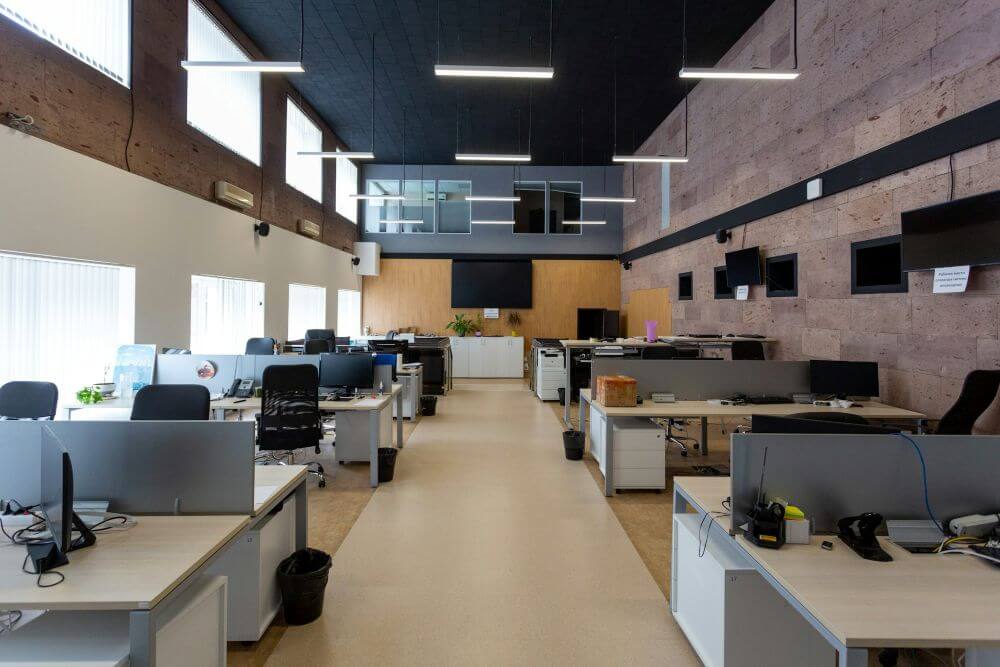
Shared workspaces sound great in theory.
Collaboration happens. Creativity flows. Teams feel unified. But the truth is… open offices sabotage productivity. They slowly suck the life out of your employees’ ability to concentrate, deplete their energy and decrease your team’s overall output daily.
Here’s the thing…
Most businesses don’t realize how many hours are wasted dealing with white noise, drop-in conversations and general office clutter. The best part is that it’s not a difficult problem to correct. It just requires a combination of solutions.
What’s covered:
- Why Shared Workspaces Cause So Many Distractions
- The Real Cost Of Office Interruptions
- How Breakout Area Dividers Change The Game
- Practical Strategies That Reduce Distractions
Why Shared Workspaces Cause So Many Distractions
Shared workspaces have one big problem – there are zero physical boundaries.
Essentially every phone conversation, keyboard click, hallway discussion and coffee break occurs inches away from someone trying to do their work. Throw open floor plans, glass partitions and hot-desking into the equation and it’s nearly impossible to shield deep work.
The most common distractions in shared offices include:
- Loud phone calls and video meetings
- Colleagues stopping by for a “quick chat”
- Foot traffic and background movement
- Constant Slack pings and notifications
- General office noise from printers, kitchens and doors
One of the quickest solutions is to introduce physical barriers. A quality office floor screen divider can instantly break sightlines, minimise noise and help people feel like they have their own personal space – without having to rebuild the office.
Breakout dividers are helpful because they allow you to create pockets of quiet spaces within communal areas. Essentially, groups can confer, work, or take phone calls privately without disrupting others nearby. Easy-peasy!
The Real Cost Of Office Interruptions
Distractions aren’t just annoying. They’re expensive.
Studies have found the average worker is interrupted 275 times a day. If every time you lose focus you take a few minutes to get back into flow, that can add up to hours lost by the time Friday rolls around.
But it gets worse…
Approximately 81% of employees report that they are often distracted during office hours. US companies lose over $650 billion annually as a result.
That’s not a small number.
Here’s what all those interruptions actually cost a business:
- Slower project delivery
- More mistakes and re-work
- Lower quality thinking on important tasks
- Rising stress and employee burnout
- Higher staff turnover over time
It’s a simple point. If a team is getting distracted all day they’re not doing their best work. Productivity software will never solve that if your real problem is the physical environment.
How Breakout Area Dividers Change The Game
Breakout area dividers are one of the most underrated tools in modern office design.
Minimalist. Inexpensive. Portable. But they tackle one of the most obnoxious office annoyances we know: visual and auditory clutter.
Here’s why they work so well:
- They obstruct views: Movement is one of the largest attention killers. Dividers eliminate that.
- They absorb noise: Sound waves are absorbed by acoustic and fabric dividers, rather than reflecting.
- They create zones: Suddenly a big open space feels like several purpose-built areas.
- They’re flexible: Move them, rearrange them, or scale up when the team grows.
- They’re cheap: Dividers run you only a fraction of the price of actual construction / renovations.
And the best part? It doesn’t have to cost a lot of money. A couple breakout area dividers can change the acoustics and experience of a shared office space drastically.
Now let’s look at how to layer other strategies on top…
Practical Strategies That Reduce Distractions
Breakout area dividers aren’t the whole solution. Here are some additional tips for establishing focus in a communal workspace.
Create Dedicated Focus Zones
Not every part of the office needs to be collaborative.
Dedicate an area as a no phone zone / silent zone, where meetings, phone conversations and loud talking can’t happen. It provides an area for people to retreat when they need to focus instead of having to wear headphones all day.
Zones work best when they are:
- Physically separated (dividers help with this)
- Clearly labelled so everyone knows the rules
- Big enough for at least 4-6 people
- Kept away from high-traffic areas like kitchens
Introduce Clear Workspace Rules
Rules only work when everyone knows them.
A few simple guidelines can dramatically reduce interruptions. For example:
- Use meeting rooms for all calls longer than 5 minutes
- Signal focus time with a visible indicator (like headphones or a small sign)
- No walk-ups during deep work hours
- Keep breakout chats away from active desks
The key is clarity and visibility. If the rules are difficult to understand or access, they won’t be used.
Rethink Your Meeting Culture
Meetings are one of the biggest hidden distractions in any shared office.
Meetings, meetings, meetings. Reduce recurring meetings by 25-50%, eliminate status meetings in favor of asynchronous tools, and block off a few hours every day to enable heads down work. This will pay HUGE dividends for team productivity.
Invest In Noise-Cancelling Tech
Sometimes the environment is just loud – and that’s okay.
Headphones (good over-ear ones), noise cancelling ear buds and white noise machines are great solutions if you need something to mask noise when barriers don’t suffice. They work best in conjunction with acoustic panels mounted above noisy areas.
Get Employee Feedback
The people in the office every day know exactly what’s distracting them.
Ask employees what’s distracting them. Listen. Then make changes accordingly. It makes workplace design a continuous effort instead of a single project. And it demonstrates to staff that leadership cares about their experience – which goes a long way.
Bringing It All Together
Shared workspace distractions aren’t going away. Just because they aren’t going away doesn’t mean you have to put up with them.
The best offices use a mix of hard tactics (divider walls for breakout spaces) and simple policies (focus hours, improved meeting culture) to establish an environment where heads down work can occur.
Quick recap:
- Break up open spaces with dividers and physical barriers
- Carve out quiet zones for deep work
- Set clear, visible rules everyone can follow
- Cut back on unnecessary meetings
- Layer in noise-cancelling tech where needed
- Ask employees for feedback and adjust
Small steps. Choose one or two of these solutions, implement them this month and monitor employee response. They’ve likely been waiting for someone to solve this problem forever.
